The Presbyterian Church in Embangweni
Although not the only religious organization in Embangweni, the Presbyterian
Church is certainly the most visible. The church building was erected in
1910, a large brick structure with marvelous round brick columns supporting
the interior roof. 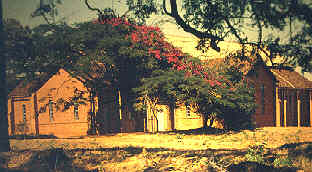 The
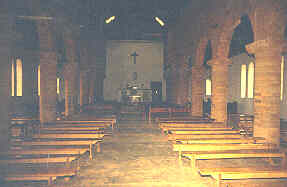
furnishings are spartan: wooden benches for the worshipers line both sides
of the center aisle (men and women sit on separate sides of the room);
a communion table and a few chairs grace the chancel. There are copies
of the Presbyterian Hymnbook (the red-covered one) and those who have them
bring paperbound copies of "Songs for Worship".
The
furnishings are spartan: wooden benches for the worshipers line both sides
of the center aisle (men and women sit on separate sides of the room);
a communion table and a few chairs grace the chancel. There are copies
of the Presbyterian Hymnbook (the red-covered one) and those who have them
bring paperbound copies of "Songs for Worship".
 There
is of course no electricity and no heat; the building can be quite chilly
at 8:00 am English worship.
There
is of course no electricity and no heat; the building can be quite chilly
at 8:00 am English worship.
Two worship services are held each Sunday: one in English and one in
Chitimbuka. The order of worship is fairly familiar to Western Presbyterians.
Hymns are sung acappella; there is no musical instrument available. While
the tunes may look familiar, we found they often flowed off into distinctly
African rhythms and tunes, highly influenced by the English church style.
Introduction of visitors was always made, with visitors coming to the front
and saying a few words of greeting. The same was done when someone was
leaving the church. More often than not, the service was run and the sermon
given by a lay member. The minister and head of station, Rev. Chunga,
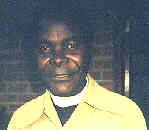 frequently was visiting outlying congregations.
While we were there, the Church received copies of the Book of Order
in English and was able for the first time to celebrate Communion in English.
Jim & I were highly honored to be invited to help serve at this service.
We did not understand, when Rev. Chunga asked whether we had our "uniforms"
with us; it seemed to be of grave concern that we did not. Arriving at
the Church to prepare for communion, we began to understand. Everyone else
was dressed in a white coat (for men) or white blouse with black pants
or skirt. So that we would not stand out (dressed as we were in normal
church clothes), we were given lime green choir robes recently sent over
in a donations box. I'm quite sure that the two white faces above green
robes were not obvious in the least! Dress aside, we were extremely moved
by the seriousness and reverence with which communion was prepared. Before
being handed the elements to carry into the church, everyone took part
in ritual hand washing --- a symbol of the washing away of sin.
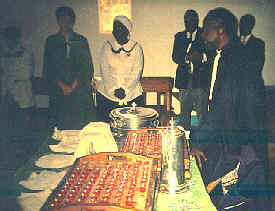 We
formed a procession in the sacristy and carried in the elements and the
table cover. After the service we again processed out, singing a hymn which
was continued in the sacristy until the elements had been replaced on the
sacristy table and re-covered. Only after a final prayer did anyone speak.
It was truly an awe-some experience.
We
formed a procession in the sacristy and carried in the elements and the
table cover. After the service we again processed out, singing a hymn which
was continued in the sacristy until the elements had been replaced on the
sacristy table and re-covered. Only after a final prayer did anyone speak.
It was truly an awe-some experience.